
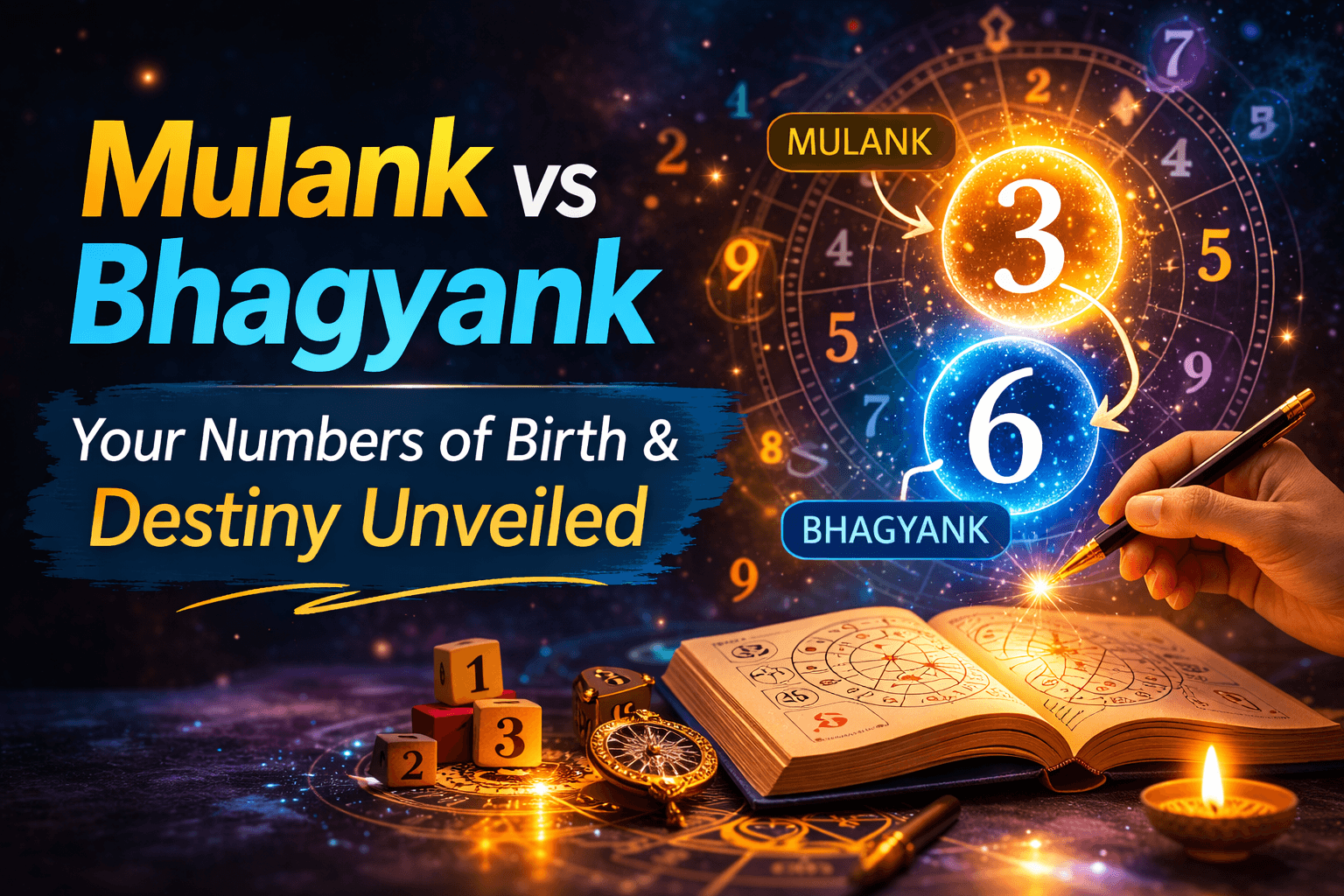
Mulank vs Bhagyank: Your Numbers of Birth & Destiny Unveiled
Kundli ReadingUnderstanding Your Cosmic Code: Mulank vs. Bhagyank
In the ancient science of numerology, every individual is believed to be influenced by a unique set of numbers that govern their personality, choices, and destiny. Among the most pivotal are the Mulank, or Psychic Number, and the Bhagyank, or Destiny Number. While both are derived from your birth date, they shed light on distinct aspects of your life. Understanding the difference between Mulank and Bhagyank can offer profound insights into your inherent nature and destined path.
What is Mulank (Psychic Number)?
Your Mulank, often referred to as your Psychic Number or Birth Number, is derived from the single digit of your birth date. For instance, if you were born on the 15th, your Mulank would be 1+5 = 6. If you were born on the 29th, it would be 2+9 = 11, then 1+1 = 2. This number represents your core personality, natural talents, daily behavior, and how others perceive you on a surface level. It influences your desires, temperament, and immediate reactions to life’s situations.
- Calculation: Simply reduce your day of birth to a single digit (e.g., 23rd = 2+3=5).
- Influence: Personality traits, daily actions, inner desires, natural inclinations.
What is Bhagyank (Destiny Number)?
The Bhagyank, also known as your Destiny Number or Life Path Number, is calculated by summing all digits of your full birth date (day, month, and year) and reducing it to a single digit. This number reveals your life’s purpose, your ultimate potential, the opportunities and challenges you’ll encounter, and the overall direction of your journey. It represents your latent abilities, your broader life lessons, and the path you are destined to walk.
- Calculation: Sum all digits of your full birth date (DD/MM/YYYY) and reduce to a single digit. For example, if born on 15/05/1990, calculate 1+5+0+5+1+9+9+0 = 30, then 3+0 = 3.
- Influence: Life path, destiny, long-term goals, inherent talents, ultimate potential, lessons to learn.
The Core Difference Between Mulank and Bhagyank
The primary difference between Mulank and Bhagyank lies in what they represent:
- Mulank (Inner Self): Describes your innate personality, your conscious mind, and how you interact with the world on a day-to-day basis. It’s the ‘who you are’ in your immediate environment.
- Bhagyank (Outer Path): Describes your life’s purpose, your karmic journey, and the opportunities and challenges that guide you towards your ultimate destiny. It’s the ‘what you are meant to do and become’ over your lifetime.
Think of Mulank as the vehicle you drive and Bhagyank as the destination of your journey.
Which is More Important: Mulank or Bhagyank?
Neither is ‘more important’; rather, they are complementary. Your Mulank describes your tools and inherent personality traits, while your Bhagyank describes the blueprint of your life’s journey. A strong understanding of both allows for harmonious living.
- Your Mulank empowers you to understand your strengths and weaknesses in daily interactions.
- Your Bhagyank guides you towards fulfilling your highest potential and understanding your life’s true purpose.
They work in tandem. For instance, if your Mulank suggests a creative personality but your Bhagyank points towards a leadership role, you might find your destiny in creative leadership.
How Mulank and Bhagyank Influence Your Personal and Professional Life
Personal Life
Your Mulank reveals your emotional nature, your communication style, and how you approach relationships. A Mulank 1 person might be independent and leading, while a Mulank 6 might be nurturing and family-oriented. Your Bhagyank, on the other hand, might reveal patterns in your long-term relationships, the types of people you attract for life lessons, or your overall approach to commitment and family values.
Professional Life
In the professional sphere, your Mulank can indicate your preferred working style, your immediate career aspirations, and how you perform in daily tasks. A Mulank 8 might be driven and business-savvy, excelling in management. Your Bhagyank, however, often points to your ultimate career path, the industry where you’ll find true fulfillment, or the larger impact you’re meant to make. For example, a Mulank 3 (creative, communicative) with a Bhagyank 9 (humanitarian, universal love) might excel as a motivational speaker or an artist whose work inspires social change.
Exploring Best Mulank and Bhagyank Combinations
While every combination is unique, some Mulank and Bhagyank pairings are considered particularly harmonious, indicating that your personality (Mulank) naturally aligns with your destiny (Bhagyank). For instance, a Mulank 1 (leader) and Bhagyank 8 (material success, power) can create an exceptionally strong individual destined for significant achievement. Conversely, combinations where the numbers present inherent challenges might signify greater learning curves or the need to integrate seemingly opposing forces within oneself to achieve balance.
Conclusion
The study of Mulank and Bhagyank offers a powerful lens through which to view your life. By understanding what is Mulank and Bhagyank, how to calculate Bhagyank, and the subtle difference between Mulank and Bhagyank, you gain invaluable self-awareness. This knowledge empowers you to leverage your innate strengths, navigate challenges with greater insight, and align your daily actions with your ultimate destiny, leading to a more purposeful and fulfilling life.
เปลี่ยนวิกฤตให้เป็นโอกาสด้วยการเล่นอย่างมีกลยุทธ์แทนการใช้อารมณ์ ทำความเข้าใจจังหวะการออกรางวัลโบนัสสล็อต เพราะระบบ RNG (Random Number Generator) ไม่ได้ถูกออกแบบมาให้จ่ายรางวัลอย่างสม่ำเสมอ https://wm787playgo.xyz/
จงเรียนรู้ที่จะรอให้เซิร์ฟเวอร์เริ่มปล่อยรางวัลใหญ่ก่อนที่จะกลับมาเล่นต่อ ให้สังเกตสัญญาณเตือนบนหน้าจอ: หากคุณหมุนวงล้อไปแล้ว 20–30 ครั้งโดยไม่พบสัญลักษณ์พิเศษหรือ Scatter เลย และได้รับเพียงรางวัลเล็กน้อยที่ไม่คุ้มค่ากับเงินเดิมพัน คุณควรระมัดระวังเรื่องเงินทุน นี่เป็นสัญญาณชัดเจนว่าเกมเข้าสู่โหมด “ตึง” ที่ออกแบบมาเพื่อดูดเงินทุนของคุณ wm787play
อย่าหลอกตัวเองว่าโบนัสใกล้จะออกแล้ว ยิ่งคุณหมุนต่อไปเรื่อยๆ คุณก็ยิ่งตกเป็นเหยื่อของระบบสุ่มและเสี่ยงที่จะสูญเสียเงินทุนทั้งหมด แนวทางที่ดีที่สุดคือการทดสอบระบบด้วยเครดิตฟรีของคาสิโนแทนการใช้เงินจริง เพื่อลดความเสี่ยงในการขาดทุน wm787online