
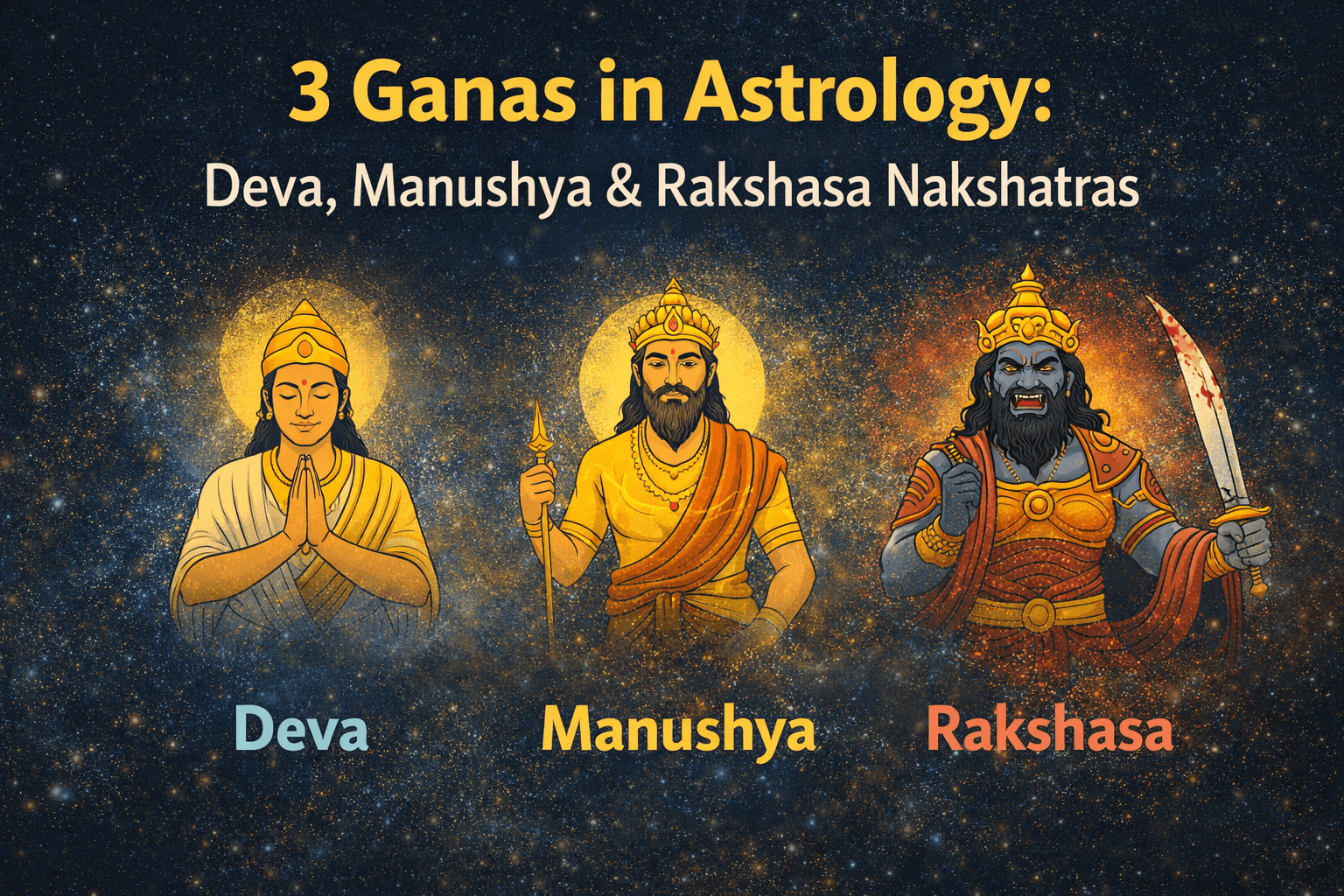
The 3 Ganas in Vedic Astrology: Deva, Manushya & Rakshasa Explained
Kundli ReadingIn Vedic astrology, every person is born under a Nakshatra (constellation), and each Nakshatra is classified into one of three Ganas:
- Deva Gana (Divine)
- Manushya Gana (Human)
- Rakshasa Gana (Demonic)
But don’t be misled by the names — Rakshasa Gana doesn’t mean bad, and Deva Gana doesn’t mean perfect. These Ganas describe basic personality types and how people behave, react, and form relationships.
Let’s understand what these Ganas mean, how they influence compatibility, and which Nakshatras fall under each.
What Are Ganas in Astrology?
The Gana system is a classification of temperament. Each Nakshatra is assigned a Gana based on ancient astrological wisdom, reflecting the core nature of a person.
It affects:
- Personality traits
- Emotional response
- Compatibility in relationships (Gana Milan in Kundli Matching)
1. Deva Gana (Divine Nature)
These individuals are polite, spiritual, peace-loving, and soft-spoken. They tend to be kind-hearted, generous, and easily adapt to positive environments.
Deva Gana Nakshatras:
- Ashwini
- Mrigashira
- Punarvasu
- Pushya
- Hasta
- Anuradha
- Revati
Traits:
- Emotionally balanced
- Respectful and humble
- Avoid conflicts
- Spiritual leanings
Best suited with: Deva or Manushya Gana
2. Manushya Gana (Human Nature)
These are practical, balanced, and goal-oriented people. They’re capable of both good and bad depending on situations. They make good leaders and decision-makers.
Manushya Gana Nakshatras:
- Bharani
- Rohini
- Ardra
- Purva Phalguni
- Uttar Phalguni
- Purva Ashadha
- Uttar Ashadha
- Shatabhisha
- Swati
Traits:
- Socially balanced
- Practical and analytical
- Strong communication skills
- Emotionally complex
Best suited with: Manushya or Deva Gana
3. Rakshasa Gana (Warrior/Natural Rebel Nature)
These natives are intense, powerful, and mentally sharp. They are not necessarily negative — but are more aggressive, direct, and bold. They challenge norms and are fearless.
Rakshasa Gana Nakshatra List:
- Kritika
- Ashlesha
- Magha
- Chitra
- Vishakha
- Jyeshtha
- Mula
- Dhanishta
Traits:
- Strong opinions
- Competitive, dominating
- Deep thinkers, can appear mysterious
- Strong survival instincts
Best suited with: Rakshasa or Manushya Gana
Gana Compatibility in Marriage
In Kundli matching (Guna Milan), Gana matching is important.
Here’s how compatibility is judged:
| Gana Combination | Compatibility Score (out of 6) | Interpretation |
| Deva + Deva | 6 | Excellent match |
| Deva + Manushya | 5 | Good match |
| Deva + Rakshasa | 1 | Poor match (clash of values) |
| Manushya + Manushya | 6 | Excellent match |
| Manushya + Rakshasa | 5 | Acceptable with understanding |
| Rakshasa + Rakshasa | 6 | Great match for similar energy |
Even if Gana matching fails, remedies from Lal Kitab or KP Astrology can help balance the energies. Explore Remedies Course
Real-World Example
Imagine a calm, spiritual Deva Gana person married to a fiery Rakshasa Gana partner. One prefers meditation, the other prefers action. Without awareness, clashes can occur. But with understanding — they can balance each other perfectly.
Related Courses
If you wish to go deeper into Nakshatras and their hidden meanings, start with these courses:
FAQs
Q.1 What is the purpose of Gana classification?
To understand personality type and compatibility in relationships and marriage.
Q.2 Can Gana mismatch in marriage be fixed?
Yes. With remedies and strong planetary support, it can be balanced.
Q.3 Is Rakshasa Gana bad?
No. It symbolizes strength and individualism. It’s only bad if misunderstood.
Final Thoughts
Understanding Ganas helps you know your inner nature, choose better partners, and respond to life with more awareness.
Whether you’re Deva, Manushya, or Rakshasa — each Gana has strengths. Astrology is a mirror, not a judgment.
Curious to learn more about your Nakshatra and Gana?
Great post! I found it interesting that despite the names, the Rakshasa Gana isn’t necessarily bad. I always thought it was associated with negative traits, but your explanation shows there’s much more depth to it. The emphasis on compatibility also made me realize how important these classifications are in Kundli matching.